 POWER SYSTEMS |
 NEWS NEWS  EVENTS EVENTS |
 BOOKS BOOKS  BLOG BLOG |
 UNIVERSITIES UNIVERSITIES  NIKOLA TESLA NIKOLA TESLA |
 LINKS LINKS  CONTACT CONTACT |
 |
POWER SYSTEMS |
 |
| BOOKS
EEE
< PREVIOUS EEE
NEXT > S.K. Salman - Introduction to the Smart Grid O. Elgerd - Electric Power Engineering J.C. Das - Transients in Electrical Systems: Analysis, Recognition, and Mitigation S.H. Horowitz - Power System Relaying A. Moreno-Munoz - Large Scale Grid Integration of Renewable Energy Sources B. M. Weedy - Electric Power Systems N. Jenkins - Renewable Energy Engineering A.R. Messina - Wide Area Monitoring of Interconnected Power Systems J. Northcote-Green - Control and Automation of Electrical Power Distribution Systems S. Vadari - Electric System Operations: Evolving to the Modern Grid
< PREVIOUS EEEEEE
NEXT >
EEEEEEEE
Showing 161 to 170 from 247 books In order to extend the content of this website, we invite you to contribute any information, including news, events, books, blog posts, universities, links, etc., you find helpful about power system engineering. |
J. Northcote-Green - Control and Automation of Electrical Power Distribution Systems Control and Automation of Electrical Power Distribution Systems (Power Engineering Book 29) 1st Edition by James Northcote-Green, Robert G. Wilson Publisher : CRC Press; 1st edition (December 19, 2017) Publication date : December 19, 2017 Language : English Print length : 488 pages 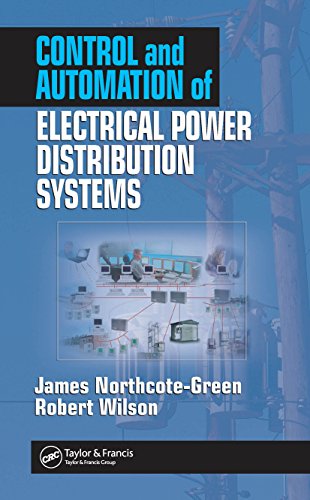 Implementing the automation of electric distribution networks, from simple remote control to the application of software-based decision tools, requires many considerations, such as assessing costs, selecting the control infrastructure type and automation level, deciding on the ambition level, and justifying the solution through a business case. Control and Automation of Electric Power Distribution Systems addresses all of these issues to aid you in resolving automation problems and improving the management of your distribution network. Bringing together automation concepts as they apply to utility distribution systems, this volume presents the theoretical and practical details of a control and automation solution for the entire distribution system of substations and feeders. The fundamentals of this solution include depth of control, boundaries of control responsibility, stages of automation, automation intensity levels, and automated device preparedness. To meet specific performance goals, the authors discuss distribution planning, performance calculations, and protection to facilitate the selection of the primary device, associated secondary control, and fault indicators. The book also provides two case studies that illustrate the business case for distribution automation (DA) and methods for calculating benefits, including the assessment of crew time savings. As utilities strive for better economies, DA, along with other tools described in this volume, help to achieve improved management of the distribution network. Using Control and Automation of Electric Power Distribution Systems, you can embark on the automation solution best suited for your needs. Table of Contents POWER DELIVERY SYSTEM CONTROL AND AUTOMATION Introduction Why Distribution Automation Power Delivery Systems Control Hierarchy What Is Distribution Automation Distribution Automation System Basic Architectures and Implementation Strategies for DA Definitions of Automated Device Preparedness Summary CENTRAL CONTROL AND MANAGEMENT Introduction Power System Operation Operations Environment of Distribution Networks Evolution of Distribution Management Systems Basic Distribution Management System Functions Basic of a Real-Time Control System (SCADA) Outage Management Decision Support Tools Subsystems Extended Control-Feeder Automation Performance Measures and Response Times Data Base Structures and Interfaces Conclusions Appendix 2A: Sample Comprehensive CIM Structure DESIGN, CONSTRUCTION AND OPERATION OF DISTRIBUTION SYSTEMS, MV NETWORKS Introduction Design of Networks LV Distribution Networks Switchgear for Distribution Substations and LV Networks Extended Control of Distribution Substations and LV Networks Summary HARDWARE FOR DISTRIBUTION SYSTEMS Introduction to Switchgear Primary Switchgear Ground Mounted Network Substations Larger Distribution/Compact Substations Pole Mounted Enclosed Switches Pole Mounted Reclosers Pole Mounted Switch Disconnectors and Disconnectors Operating Mechanisms and Actuators Current and Voltage Measuring Devices Instrument Transformers in Extended Control Current and Voltage Sensors PROTECTION AND CONTROL Introduction Protection Using Relays Sensitive Earth Fault and Instantaneous Protection Schemes Protection Using Fuses Earth Fault and Overcurrent Protection for Solid/ Resistance Earthed Networks Earth Faults on Compensated Networks Earth Faults on Unearthed Networks An Earth Fault Relay for Compensated and Unearthed Networks Fault Passage Indication Connection of the FPI to the Distribution System Conductor Distribution System Earthing and Fault Passage Indication AutoReclosing and Fault Passage Indicators The Choice of Indication between Phase Fault and Earth Fault Resetting the Fault Passage Indicator Grading of Fault Passage Indicators Selecting a Fault Passage Indicator Intelligent Electronic Device (IED) Power Supplies for Extended Control Automation Ready Switchgear - FA Building Blocks Examples of Building Blocks Typical Inputs and Outputs for Building Blocks Control Building Blocks and Retrofit Control Logic PERFORMANCE OF DISTRIBUTION SYSTEM Faults on Distribution Networks Performance and Basic Reliability Calculations Calculating the Effects of Extended Control Improving the Reliability of Underground Networks Improving the Reliability of Overhead Networks Improving Performance with Automation Improvements by Combining Design Methods on Underground Circuits COMMUNICATION SYSTEMS FOR CONTROL AND AUTOMATION Introduction Communications and Distribution Automation DA Communication Physical Link Options Wireless Communication Wire Communications Distribution Automation Communications Protocols Distribution Automation Communications Architecture DA Communications User Interface Some Considerations for DA Communications Selection Requirements for Dimensioning the Communications Channel Glossary of Communication Terms Used CREATING THE BUSINESS CASE Introduction Potential Benefits Perceived by the Industry for Substation Automation Potential Benefits Perceived by the Industry for Feeder Automation Generic Benefits Benefits Opportunity Matrix Benefits Flow Chart Dependencies, Shared and Unshared Benefits Capital Deferral, Release, or Displacement Savings in Manpower Savings Related to Energy Other Operating Benefits Summary of DA Functions and Benefits Economic Value-Cost Presentation of Results and Conclusion CASE STUDIES Introduction Case Study 1, Long Rural Feeder Case Study 2, Large Urban Network 

|